Wisconsin Owner-Builder Permit Kit
Wisconsin has no permit-free town and no holding period on the owner exemption — but it does have two zone maps numbered backwards from each other, and a septic permit that has to come first.
One-time payment · Instant download · Part of the Job Site Binder family
Six documents, 52 pages
Letter size
Tap a page to read it
Cover & How to Use
A job-site cover with a “Who Enforces the UDC” line, because in Wisconsin that has four possible answers and none of them is “nobody”. Plus the orientation and the statute that reorders a rural build.
Owner-Builder Exemption Walkthrough
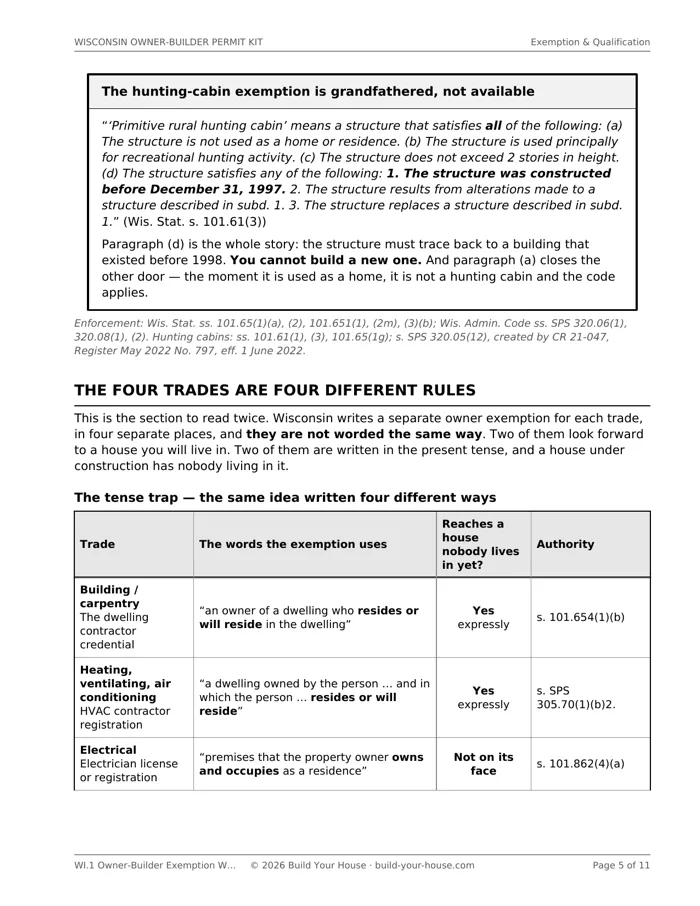
The one-sentence exemption, what it does not lift, and then the four trades — which are four separately worded rules. Includes the worker’s compensation triggers, the nine-part subcontractor test, and Wisconsin’s owner-milled lumber provision.
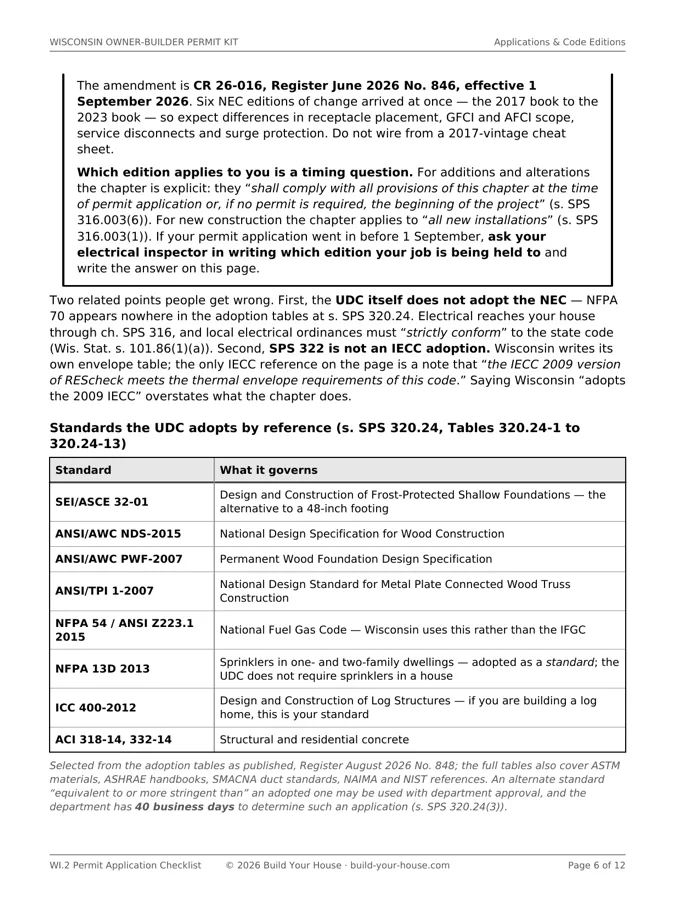
Permit Application Checklist
What to gather in the order Wisconsin makes you gather it — sanitary permit, then plans, then the uniform permit. Plus every code edition in force, the full prescriptive energy table, the frost rule, and three shot clocks.
Inspection Sequence
The eight inspection types the code names, the three clocks that let you keep working or move in when the inspector does not show, the weather rules that stop a septic install, and a log.
Where to File Directory
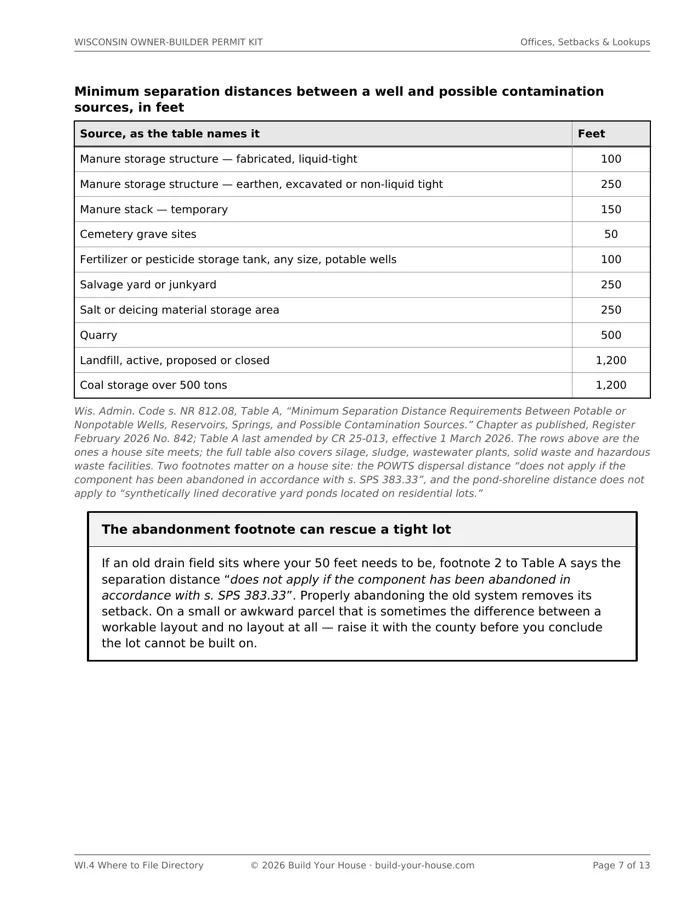
The two Department documents that resolve any parcel in the state — and almost nobody knows they exist. Plus the well and septic separation distances that decide where the house can actually go, the shoreland standards, and the floodplain rules.
Forms & Documents Index
Every document you will meet, who produces it and where it goes — plus the twelve exemptions from the code, the two that are not really exemptions, and what to ask a subcontractor to show you.
What the kit knows that the internet doesn’t
All checkable
Four things Wisconsin law actually says that the standard advice gets wrong. Each takes about a minute to check.
Wisconsin left the 2017 NEC on 1 September 2026
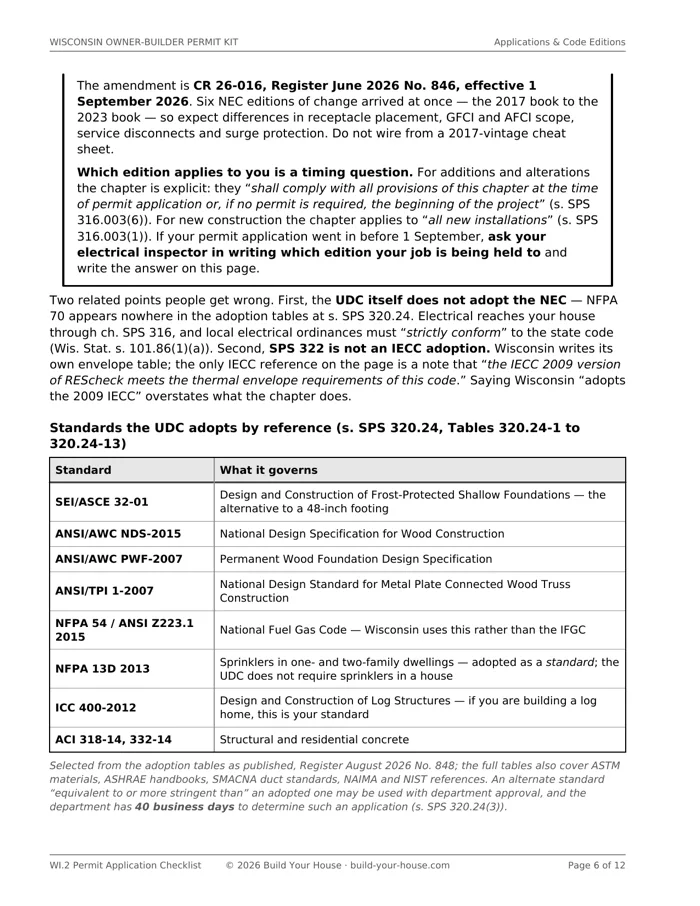
Every Wisconsin guide in circulation says the state is on the 2017 National Electrical Code. It stopped being true this month. SPS 316.007(1)(a) now adopts “NFPA 70 National Electrical Code, (NEC) – 2023,” by CR 26-016, Register June 2026 No. 846, effective 1 September 2026. Six editions of change arrived at once, and which one binds your job turns on your permit application date.
Two zone maps, numbered backwards from each other
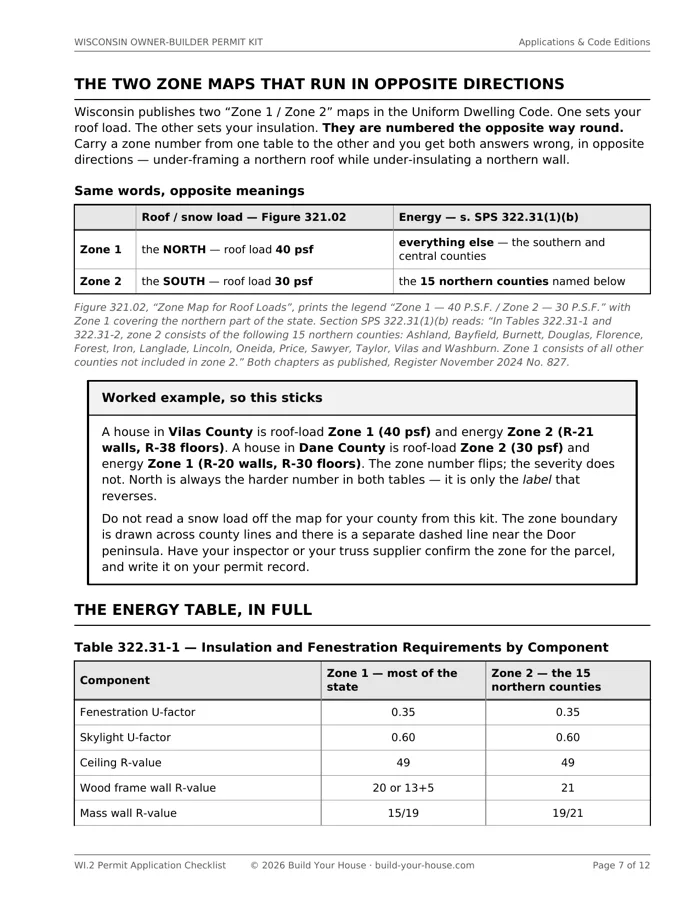
Figure 321.02 sets roof loads with Zone 1 as the north at 40 psf and Zone 2 as the south at 30 psf. SPS 322.31(1)(b) sets insulation with zone 2 as the 15 northern counties and zone 1 as everywhere else. The labels are inverted. Carry one number across and you under-frame a northern roof while under-insulating a northern wall — both wrong, in opposite directions.
No permit-free town, and no holding period
If your municipality has not taken up enforcement, “the department shall provide inspection services and shall enforce this subchapter throughout” it (s. 101.651(3)(b)), and larger municipalities must contract for what they do not perform (s. 101.65(2)). But the owner exemption is one sentence with no strings: s. 101.654(1)(b) asks only that you “reside or will reside” in the dwelling. No holding period, no resale bar, no affidavit — the “two years” people cite is the continuing-education cycle for certified contractors.
You may drill your own well. You may not install your own septic.
NR 812.10(1)(a) exempts “an individual performing well drilling on real estate owned or leased by that individual” — though you must notify the Department before construction begins (s. 281.34(3)(a)). Septic is the reverse: the sanitary permit application cannot be completed without naming the master plumber responsible for the installation (SPS 383.21(2)(c)4.), and by statute that permit must be in hand before your building permit can issue (s. 145.195(1)).
Every claim was read against its primary source in September 2026: the Wisconsin Statutes and Administrative Code at docs.legis.wisconsin.gov, and the Department of Safety and Professional Services’ own delegation list, inspection map and owner brochure at dsps.wi.gov. Each table reproduced here was additionally rendered and read from the official PDF page, because the two-column code layout corrupts numbers in text extraction.
Get the permit kit
Instant download
The Wisconsin Owner-Builder Permit Kit
What you get
- 52 print-ready pages across 6 documents, letter size
- Every Wisconsin claim cited on the page it appears on
- The NR 812 well separation distances and the SPS 383 septic setbacks in full
- A permit record and an inspection log for the job site
- Lifetime access — re-download anytime with your purchase email
DeliveryInstant download the moment payment clears.
FormatPrint-ready PDFs, letter size. Print at home or at a copy shop.
Verify locallyCode editions change — Wisconsin’s electrical code changed on 1 September 2026, while this kit was being written. Confirm each rule with whoever enforces the Uniform Dwelling Code on your parcel, which may be your municipality, your county, the Department, or a private inspection agency under state contract, and confirm the septic side with your county. The kit prints its sources so you can.
Payment$34 one-time. No subscription, no renewal.
Frequently asked
Can you build your own house in Wisconsin without a license?
Yes. Wisconsin licenses no residential general contractor. What it has instead is a credential attached to the permit — s. 101.654(1)(a) bars anyone from obtaining a building permit without a certificate of financial responsibility — and then exempts you from it in one sentence: “Paragraph (a) does not apply to an owner of a dwelling who resides or will reside in the dwelling and who applies for a building permit to perform work on that dwelling” (s. 101.654(1)(b)). The forward-looking “will reside” is deliberate and covers a house that does not exist yet. There is no holding period, no bar on selling afterward, no dollar cap and no affidavit — the full text of the statute and both administrative rules were read to confirm it. The exemption lifts the credential only: you still pull a permit, you still meet the code, and s. 101.66(1) names “every builder, designer, and owner” personally.
Do you need a building permit everywhere in Wisconsin?
Yes. Unlike Montana, Kentucky or Mississippi, Wisconsin has no gap. A city, village or town may take jurisdiction by ordinance; a municipality of 2,500 or fewer may instead ask its county; and if neither happens, “the department shall provide inspection services and shall enforce this subchapter throughout” that municipality (s. 101.651(3)(b)). Larger municipalities that do not inspect “shall contract with the department for those inspection services which the municipality does not perform” (s. 101.65(2)). The permit must be obtained “before any on-site construction, including excavation for a structure, may begin” (SPS 320.08(1)). What varies is who you call — and in a department-jurisdiction town that is a private registered UDC inspection agency, not a town hall.
Can a homeowner do their own electrical or plumbing work in Wisconsin?
This is the question Wisconsin answers least clearly, and the kit prints the texts rather than guessing. Both owner exemptions are written in the present tense: electrical covers “premises that the property owner owns and occupies as a residence” (s. 101.862(4)(a)) and plumbing covers work “in a one-family building owned and occupied by him or her as his or her home” (s. 145.06(4)(a)). Neither says “new construction,” and neither contains the forward-looking “or will reside” that the owner-builder exemption and the HVAC exemption both do — a real drafting asymmetry. One thing does settle the practical question on plumbing: SPS 320.09(9)(a)7. requires “the name and license number of the Wisconsin master plumber responsible for the installation of plumbing” to be entered on your permit at issuance. Note also that the plumbing exemption reaches a one-family building only, so it is unavailable on a duplex, and that both exemptions can be switched off by local ordinance. Ask your inspector in writing before you buy materials.
Can I install my own septic system or drill my own well in Wisconsin?
Septic, no. Well, yes. POWTS work is “plumbing” by statutory definition (s. 145.01(10)(a)2.), the homeowner plumbing exemption reaches work “in a one-family building” and a dispersal cell is not in the building, and the sanitary permit application must be accompanied by “documentation that the master plumber or the master plumber-restricted service who is to be responsible for the installation” (SPS 383.21(2)(c)4.). The soil evaluation is also credential-gated — only a certified soil tester may do it, and three soil profile evaluations are required with at least one dug as a full pit. Wells are the opposite: NR 812.10(1)(a) says a license “is not required for … an individual performing well drilling on real estate owned or leased by that individual.” You must notify the Department of Natural Resources before construction begins, all NR 812 construction standards still apply, and coliform and nitrate samples are required afterward by rule.
What building code does Wisconsin use in 2026?
The Uniform Dwelling Code, chs. SPS 320 to 325 — Wisconsin’s own code, not an adoption of the International Residential Code. Electrical changed on 1 September 2026: SPS 316.007(1)(a) now adopts the 2023 National Electrical Code, replacing the 2017 edition, under CR 26-016. Energy is SPS 322, which writes its own prescriptive tables rather than adopting the IECC — the only IECC reference is a note that the 2009 REScheck version meets the thermal envelope requirements. Fuel gas is NFPA 54, the National Fuel Gas Code, rather than the IFGC. Frost footings are “below the frost penetration level or at least 48 inches below adjacent grade, whichever is deeper,” expressly including landings and stoops (SPS 321.16). Wisconsin does not require sprinklers in a one- or two-family dwelling. Note that SPS 324 and SPS 325 are pointer chapters — electrical actually lives in ch. SPS 316 and plumbing in chs. SPS 381 to 387.
How do I find out who inspects my house in Wisconsin?
The Department publishes two documents that together resolve any parcel in the state, and almost nobody outside the trade knows they exist. First, the UDC Delegated Municipalities List — search it for your exact municipality, which in rural Wisconsin is a Town, not the city on your mailing address. If it is listed, that municipality issues your permit and does your inspections, and the list names the contact and the inspector under contract. If it is not listed, the UDC Permit and Inspection Map tells you whether to contact your county, the Department, or one of the named private inspection agencies working under state contract. Thirteen counties hold delegation, and one county is split between two agencies. Whoever it turns out to be, you are locked to them: “a person who obtains a Wisconsin uniform building permit from a registered UDC inspection agency shall retain the same agency to conduct the inspections for the project” (SPS 320.08(2)). Choose before you file.
The free guide, and the other states
Same format
Free guideStart with the Wisconsin owner-builder guide — the free overview this kit turns into working paper.
AlaskaThe AK Permit Kit, in the same six-document format.
ArizonaThe AZ Permit Kit, in the same six-document format.
ArkansasThe AR Permit Kit, in the same six-document format.