Kentucky Owner-Builder Permit Kit
In roughly one Kentucky county in three, nobody will ever inspect your house — and you still cannot get power or water without two signatures.
One-time payment · Instant download · Part of the Job Site Binder family
Six documents, 39 pages
Letter size
Tap a page to read it
Cover & How to Use
A job-site cover with the fields Kentucky actually makes you resolve, including a Local Building Department line with an explicit instruction to write NONE. Plus the one-page orientation.
Owner-Builder Exemption Walkthrough
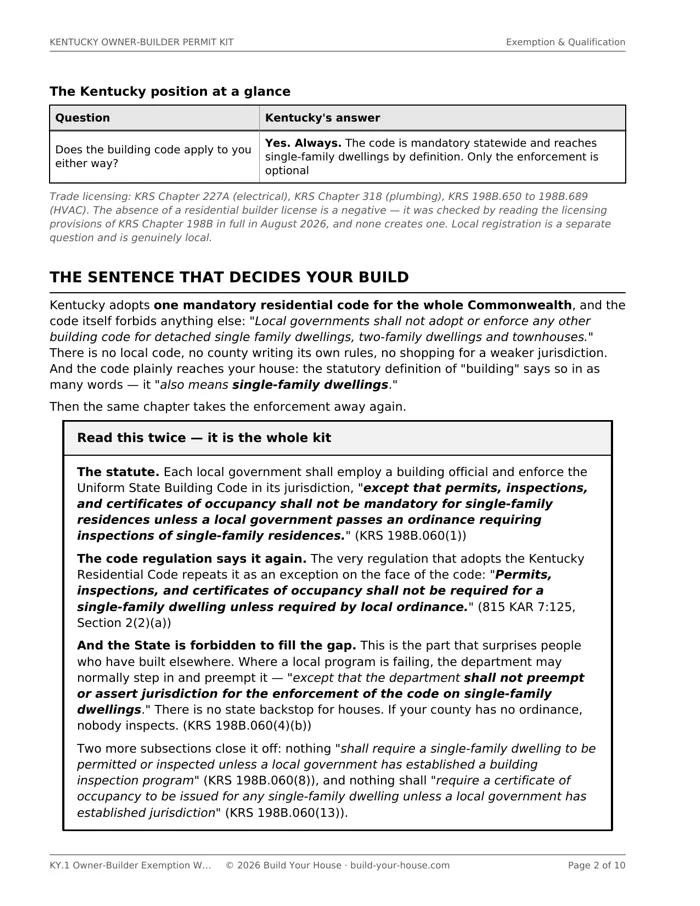
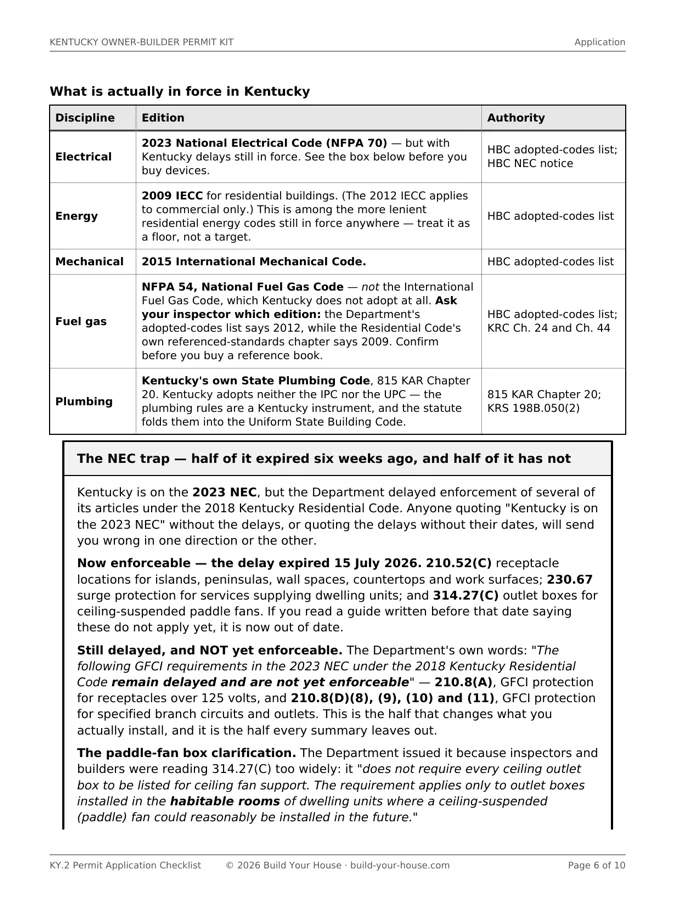
There is no Kentucky state builder license to be exempt from — so this document answers the question that actually governs your build: does a building permit exist where you are building? Then the three trade exemptions, which are three different tests, and a qualification checklist.
Permit Application Checklist
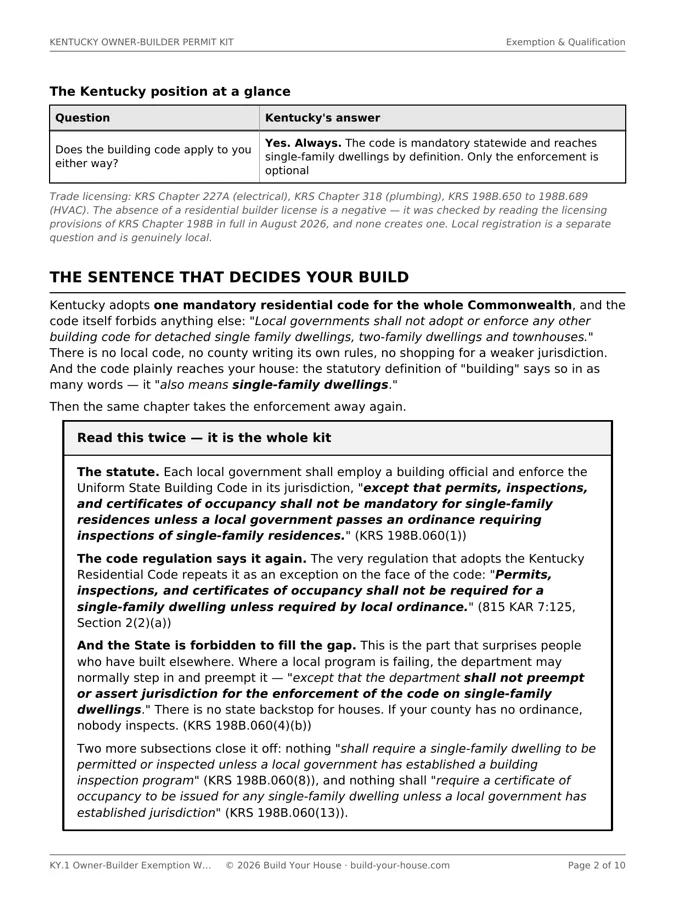
The septic permit that gates the state plumbing permit by statute, the workers compensation affidavit, every code edition in force, the NEC articles Kentucky still has not switched on, published state fees, and a permit record to fill in as each one issues.
Inspection Sequence
Split into the approvals that happen wherever you build and the building inspections that happen only if your jurisdiction requires them. Includes the one statutory inspection clock Kentucky gives you, and an inspection log.
Where to File Directory
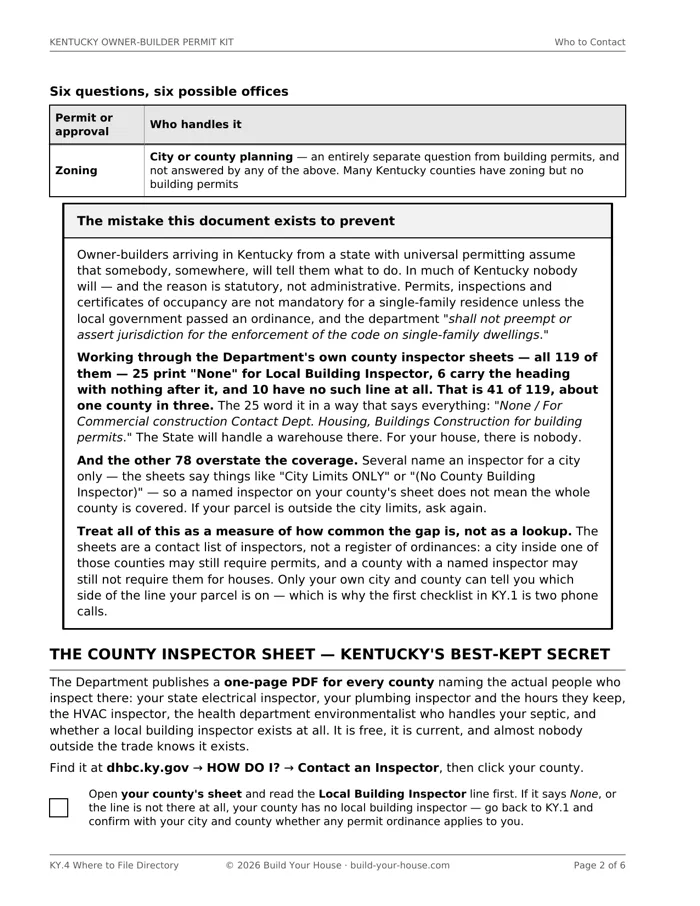
How to find the per-county inspector sheet the state publishes and almost nobody knows about — it names your plumbing inspector, their office hours, your electrical inspector and your septic contact, and tells you whether a local building inspector exists at all.
Forms & Documents Index
Every document you will meet, named as the Department names it, including the septic construction permit and the one trade a Kentucky homeowner may not do themselves — plus what needs no permit at all.
What the kit knows that the internet doesn’t
All checkable
Four things Kentucky law actually says that the standard advice gets wrong. Each takes about a minute to check.
Your building permit may not exist
Permits, inspections and certificates of occupancy “shall not be mandatory for single-family residences unless a local government passes an ordinance” (KRS 198B.060(1)), and the code regulation repeats it (815 KAR 7:125 §2(2)(a)). The state is then barred from filling the gap: it “shall not preempt or assert jurisdiction for the enforcement of the code on single-family dwellings” (KRS 198B.060(4)(b)). On the Department’s own county sheets, 41 of 119 show no local building inspector at all.
Three state permits apply anyway
The plumbing installation permit comes from the state and KRS Chapter 318 is in force “in all counties of the Commonwealth” (KRS 318.134(1)(a), 318.015(1)). An HVAC permit is required before an initial system in any building designed for human occupancy (KRS 198B.6671(1)). And your septic permit must accompany the plumbing application by statute (KRS 318.134(2)).
The utilities are the real inspectors
Once a certified electrical inspector has been provided for, no utility may “initiate permanent electrical service to any new building” without their final certificate of approval (KRS 198B.060(11)) — and all 119 published county sheets name one. No public utility or water district may provide permanent water until the plumbing is approved (KRS 318.165). On a septic site the health department gates the electricity too (KRS 211.350(8)). In a no-ordinance county those signatures are the enforcement.
Kentucky has not switched on all of the 2023 NEC
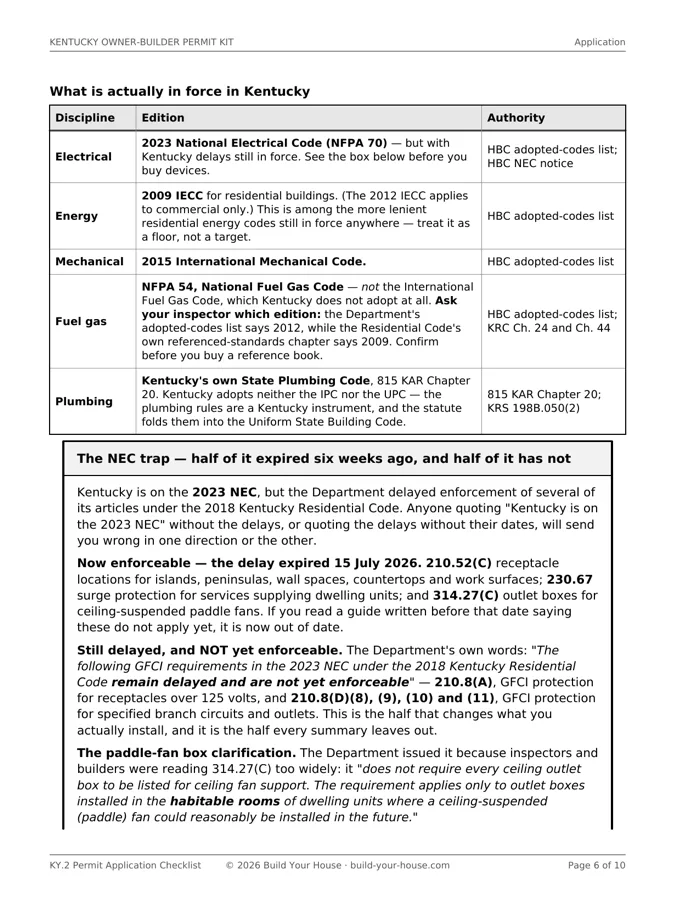
Three delayed articles — 210.52(C), 230.67 and 314.27(C) — became enforceable on 15 July 2026, so guides written earlier are stale. But 210.8(A) and 210.8(D)(8)–(11) GFCI requirements “remain delayed and are not yet enforceable,” which is the half that changes what you install. Permits issued before 15 July 2026 are grandfathered.
Every claim was read against its primary source in August 2026: the Kentucky Revised Statutes and Administrative Regulations at apps.legislature.ky.gov, and the Department of Housing, Buildings and Construction’s own adopted-code list, NEC enforcement notices and all 119 county inspector sheets at dhbc.ky.gov.
Get the permit kit
Instant download
The Kentucky Owner-Builder Permit Kit
What you get
- 39 print-ready pages across 6 documents, letter size
- Every Kentucky claim cited on the page it appears on
- Write-in lines for everything that depends on your local ordinance
- A permit record and an inspection log for the job site
- Lifetime access — re-download anytime with your purchase email
DeliveryInstant download the moment payment clears.
FormatPrint-ready PDFs, letter size. Print at home or at a copy shop.
Verify locallyStatutes, regulations and code editions change, and in Kentucky the building permit itself depends on a local ordinance. Confirm each rule with your city and your county — and with the Department for the state plumbing and HVAC permits. The kit prints its sources so you can.
Payment$34 one-time. No subscription, no renewal.
Frequently asked
Do you need a building permit to build a house in Kentucky?
Often, no. KRS 198B.060(1) says permits, inspections and certificates of occupancy “shall not be mandatory for single-family residences unless a local government passes an ordinance requiring inspections of single-family residences,” and 815 KAR 7:125 Section 2(2)(a) repeats it in the code regulation itself. The Department of Housing, Buildings and Construction cannot step in either — it “shall not preempt or assert jurisdiction for the enforcement of the code on single-family dwellings.” On the state’s own county inspector sheets, 25 counties print “None” for local building inspector, 6 leave the field empty and 10 more carry no such line at all — 41 of 119. Ask your city and your county; both answers matter.
Does the Kentucky Residential Code still apply if my county has no building permit?
Yes. The code is mandatory statewide and reaches your house by definition — KRS 198B.010(4) says “building” “also means single-family dwellings,” and the code itself bars local governments from adopting any other building code for one- and two-family dwellings and townhouses (Kentucky Residential Code R101.3). What disappears in a county with no ordinance is the inspection, not the standard and not your liability. Kentucky also adds a specific cost to skipping the certificate of occupancy: under KRS 198B.130, an award against you in a code-violation claim “may also include reasonable attorney’s fees” if no certificate of occupancy was issued, for up to ten years after first occupation.
Can a homeowner do their own electrical work in Kentucky?
Yes, and the exemption is wider than almost every guide states. KRS 227A.030(3) reads in full: “Nothing in KRS 227A.010 to 227A.140 shall prohibit or interfere with the ability of a homeowner or farmer to install or repair electrical wiring on his or her real property.” There is no occupancy condition, no single-family limitation, no requirement that you personally perform the work and no affidavit — and farmers are named expressly. It exempts you from the license only, not from the certified electrical inspector’s final certificate of approval, which your power company needs before it can connect permanent service.
Do I need a state plumbing permit in Kentucky?
Yes, wherever you build. KRS 318.134(1)(a) bars anyone from constructing or altering plumbing “without first having procured a plumbing installation permit therefor from the department,” and KRS 318.015(1) puts the chapter “in full force and effect in all counties of the Commonwealth” — with one carve-out, farmsteads. A homeowner can hold the permit under 815 KAR 20:050 Section 2(1)(b) by filing an affidavit, performing all the work personally, and not having obtained another homeowner permit for a new home in the last five years. The fee is set in regulation: $50 base plus $14 per fixture, with five inspections included.
Can I install my own septic system in Kentucky?
Yes. Permits normally issue only to certified installers, but 902 KAR 10:110 Section 2(4) allows one to be issued to a homeowner if you apply before starting and all work “is personally performed by the homeowner” — except excavation and backfill, which a certified installer may do only if you name them on the application. You may hold only one homeowner septic permit in any five-year period, and it is not available if you are building for sale or resale. The site evaluation that precedes it is not a perc test; Kentucky rates soil morphology, and the health department must complete the evaluation within 15 working days (KRS 211.350(3)). Note the contrast: you may not drill your own well — KRS 223.405 requires a certified driller and has no homeowner exemption.
What building code does Kentucky use in 2026?
The 2018 Kentucky Residential Code, Third Edition (August 2024), based on the 2015 International Residential Code, effective 3 December 2024 under 815 KAR 7:125. Electrical is the 2023 NEC, but with Kentucky delays: 210.52(C), 230.67 and 314.27(C) became enforceable on 15 July 2026, while 210.8(A) and 210.8(D)(8)–(11) GFCI requirements remain delayed. Residential energy is the 2009 IECC, mechanical is the 2015 IMC, fuel gas is NFPA 54, the National Fuel Gas Code, rather than the IFGC — the Department’s documents conflict on the edition, so ask your inspector which one — and plumbing is Kentucky’s own State Plumbing Code at 815 KAR Chapter 20. Kentucky adopts neither the IPC nor the UPC.
The free guide, and the other states
Same format
Free guideStart with the Kentucky owner-builder guide — the free overview this kit turns into working paper.
LouisianaThe LA Permit Kit, in the same six-document format.
MichiganThe MI Permit Kit, in the same six-document format.
MississippiThe MS Permit Kit, in the same six-document format.