Virginia Owner-Builder Permit Kit
Every permit, form, and inspection Virginia requires of an owner-builder — verified against the statutes, citations printed on the page.
One-time payment · Instant download · Part of the Job Site Binder family
Six documents, 31 pages
Letter size
Tap a page to read it
Cover & How to Use
What is in the kit, what order to work through it, and the six Virginia headline facts — the exemption, the code edition, the lien agent line, the septic gate, the VDOT driveway permit, and the blower door — each with its citation.
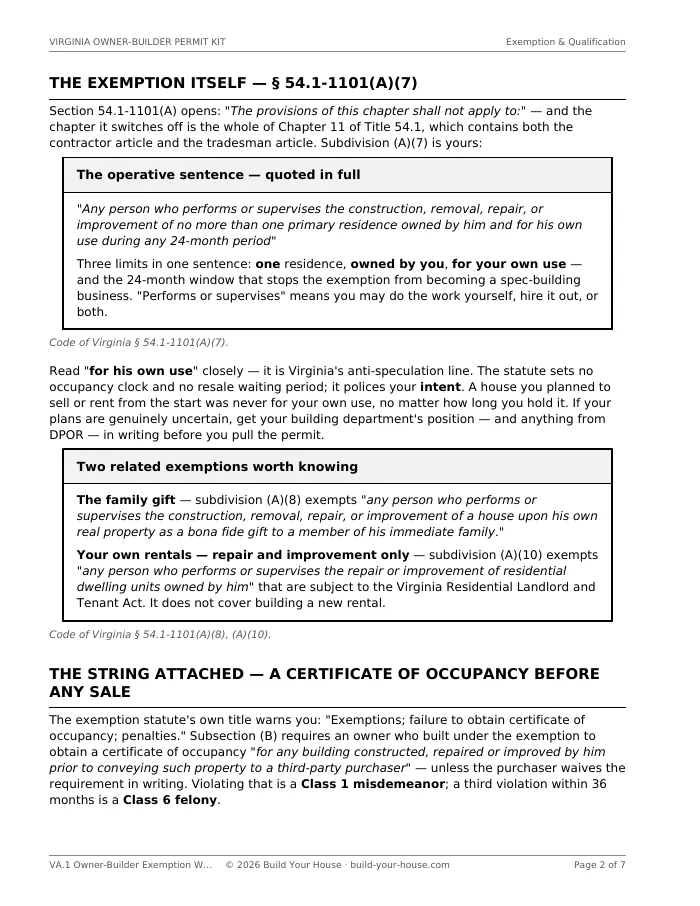
Owner-Builder Exemption Walkthrough
The license exemption, plain: one primary residence, owned by you, for your own use, in any 24-month period — § 54.1-1101(A)(7) cited on the page. What you sign at the permit counter instead of a license number — the written statement supported by an affidavit that § 54.1-1111 requires — and the certificate-of-occupancy duty that follows you to closing.
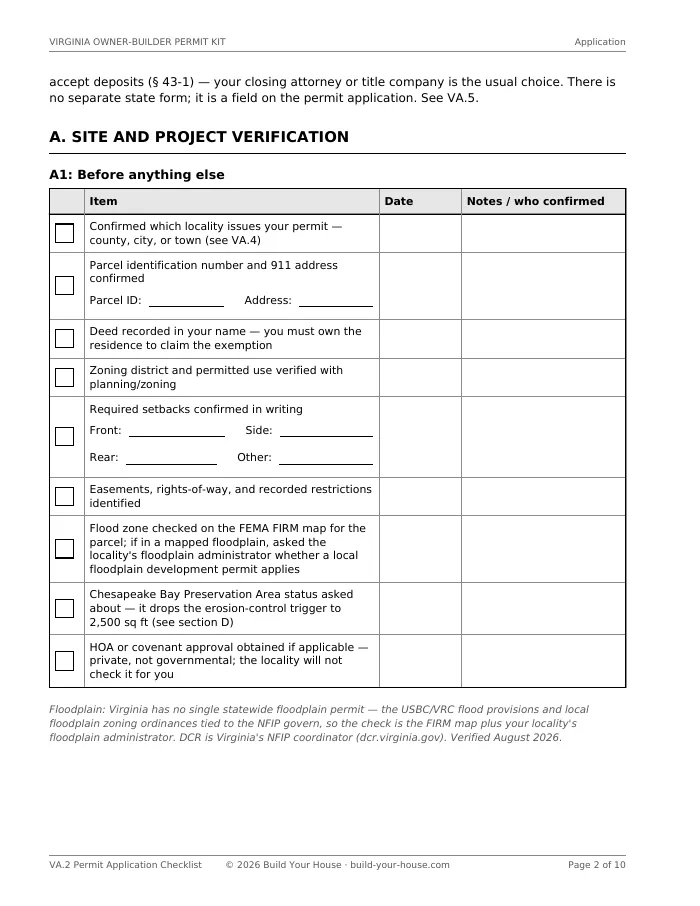
Permit Application Checklist
Everything the locality wants in the packet, in the order they ask for it: site plan, plans (no architect seal required up to three stories), septic or sewer proof, the erosion agreement in lieu of a plan, the VDOT entrance permit, and the lien agent line. Check the boxes and you have a complete application.
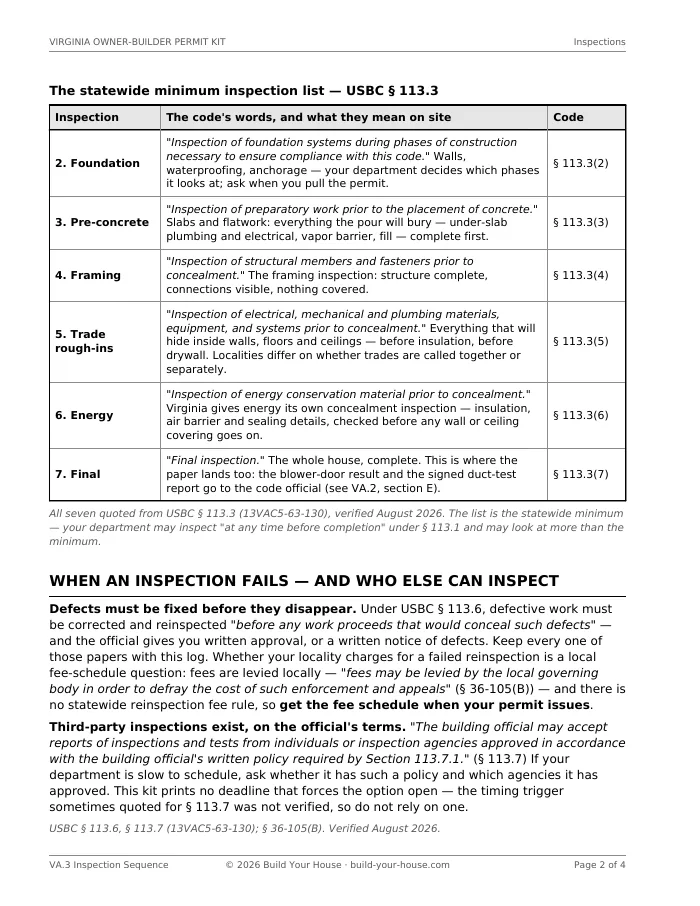
Inspection Sequence
The seven statewide minimum inspections USBC § 113.3 calls for, quoted verbatim, in the order they are called — footing through final — with what has to be finished before you schedule each one, and where the blower-door and duct-test reports land.
Where-to-File Directory
Which counter handles which piece: the local building department, the local health department for septic and wells, the erosion and stormwater office, and the VDOT district for the driveway. Plus ten of Virginia’s busiest permit counters, with department names and domains confirmed.
Forms & Documents Index
Every form referenced in the kit, with its official title and the office that issues it — including the VDOT LUP-A and LUP-PE entrance forms and the VDH sewage and water application — so you can pull a current copy yourself.
What the kit knows that the internet doesn’t
All checkable
Four things in this kit that most Virginia owner-builder advice gets wrong. Each one is checkable in a couple of minutes — which is the point of printing the citation.
The lien agent line is optional — and it protects you, not them
Virginia puts a mechanics’ lien agent line on every one- and two-family dwelling permit — filled in only if you, the applicant, request it; otherwise the permit prints “None Designated” (§ 36-98.01). Most guides skip it because it is optional. Designate one anyway: § 43-4.01 then forces anyone who wants lien rights against your title to notify the agent within 30 days of first furnishing labor or materials, or the lien is limited to work performed after notice is finally given. The kit explains who can serve and where the line goes on the application.
The blower door is mandatory — and Virginia’s number is 5, not 3
Every new Virginia dwelling gets a blower-door test — the visual-inspection alternative is gone — but Virginia amended the passing score to 5 ACH50, not the 3.0 the unamended 2021 IECC would demand. Guides that quote the raw I-Code make your target look stricter than it is. The kit prints the Virginia number, cites 13VAC5-63-264, and lists the seven categories of people allowed to run the test.
The septic office is on a 15-working-day shot clock — if you use the private lane
On an unsewered lot, septic approval gates the building permit. Wait in the general queue and you wait as long as it takes. Hire a licensed onsite soil evaluator — or a PE consulting one — and § 32.1-163.5 gives VDH 15 working days to act on a single-lot submission, or the design is deemed approved and the approval must issue. Most owner-builders never hear that the private lane exists. The kit sequences it.
Your driveway probably needs a state permit before you cut it
Virginia is one of the few states where the state, not the county, maintains most roads outside cities. Unless you are in a city, a town that maintains its streets, or Henrico or Arlington, assume the road is VDOT’s — and no entrance may be constructed in the right-of-way until VDOT has approved the location and issued an entrance permit (24VAC30-73-60). The kit names the forms — LUP-A and LUP-PE — and puts them at the front of the checklist, where access belongs.
Verified against law.lis.virginia.gov, DHCD/USBC, VDH, DEQ, and VDOT sources, August 2026 · Citations printed on each page
Get the permit kit
Instant download
The Virginia Owner-Builder Permit Kit
What you get
- 31 print-ready pages across 6 documents, letter size
- The owner-builder license exemption walkthrough (§ 54.1-1101 and § 54.1-1111)
- A permit application checklist you can work straight through
- The full USBC inspection sequence, in the order Virginia calls it
- Where-to-file directory: building, septic and well, erosion, and the VDOT driveway
- Statute and code citations printed on the page, not linked away
- Lifetime access — re-download anytime with your purchase email
DeliveryInstant download the moment payment clears.
FormatPrint-ready PDFs, letter size. Print at home or at a copy shop.
Verify locallyStatutes and code editions change. Confirm each rule with your locality — the kit prints its sources so you can.
Payment$34 one-time. No subscription, no renewal.
Frequently asked
Can I build my own house in Virginia without a contractor’s license?
Yes. Code of Virginia § 54.1-1101(A)(7) exempts any person who performs or supervises the construction of no more than one primary residence owned by him and for his own use during any 24-month period. At the permit counter you sign a written statement, supported by an affidavit, that you are not subject to licensure — § 54.1-1111 forbids the building official to issue the permit without it. The exemption never waives the building code: § 54.1-1101(C) says exempt owners must still comply with the USBC, permits and inspections included. The kit walks the conditions one at a time with the statutes cited on the page.
Do I have to live in the house? Can I sell it afterward?
Virginia polices intent rather than a calendar. The exemption is for one primary residence built for your own use in any 24-month period — a house built to sell does not qualify — but the statute sets no fixed holding period after completion, unlike North Carolina’s 12-month rule. One string is attached: § 54.1-1101(B) requires an owner who used the exemption to obtain a certificate of occupancy before conveying the property to a third-party purchaser, unless the purchaser waives in writing, and violating it is a Class 1 misdemeanor. The kit prints exactly what the statute says and no more.
What inspections are required in Virginia?
USBC § 113.3 sets the statewide minimum, seven inspections: footing excavations and reinforcement before concrete is placed, foundation systems, preparatory work before concrete, structural members and fasteners before concealment, electrical, mechanical, and plumbing before concealment, energy conservation materials before concealment, and final. Nothing counts until it is inspected and approved (§ 113.1), and defective work must be corrected and reinspected before anything conceals it. The blower-door result and the signed duct-test report land at final. The kit lays the sequence out in call order with what has to be finished before you schedule each one.
Do I need a lien agent in Virginia?
No — and that is exactly why you should think about it. Virginia puts a mechanics’ lien agent line on every one- and two-family dwelling permit, filled in at the applicant’s option; if you skip it, the permit prints “None Designated” (§ 36-98.01). Designating one — an attorney, a title insurance company, or a financial institution (§ 43-1) — forces anyone who wants lien rights to notify the agent within 30 days of first furnishing labor or materials, or their lien is limited to work performed after notice is finally given (§ 43-4.01). It is one of the cheapest pieces of title protection an owner-builder can buy.
Can I do my own electrical, plumbing, and HVAC work?
The owner exemption in § 54.1-1101 switches off the entire licensing chapter, and Virginia defines a tradesman as someone who works for the general public for compensation (§ 54.1-1128) — an owner wiring his own primary residence is neither. That conclusion is a reading of two statutes together, not a sentence you can quote, so the kit prints both statutory bases and tells you to confirm with your building official before pulling the trade permits — some departments quiz owner applicants first. Either way, every trade still needs its permit and must pass its USBC inspection.
How long does permitting take in Virginia?
The USBC sets no fixed day-count for residential plan review — the official must act within a reasonable time (§ 110.1) — so the building permit itself is rarely the long pole. The state approvals are: VDH septic on an unsewered lot, which can hold up the building permit under USBC § 103.5 and runs on a 15-working-day clock if you use a private soil evaluator; the VDOT entrance permit for a driveway onto a state-maintained road; and land-disturbance approval before any dirt moves. The kit lays out which clocks run in parallel and which have to run in order, so you can start the slow ones first. Once issued, the permit is abandoned if work does not commence within six months.
The free guide, and the other states
Same format
Free guideStart with the Virginia owner-builder guide — the free overview this kit turns into working paper.
WashingtonThe WA Permit Kit, in the same six-document format.
WisconsinThe WI Permit Kit, in the same six-document format.
AlaskaThe AK Permit Kit, in the same six-document format.